
Newsletter Subscribe
Enter your email address below and subscribe to our newsletter
Enter your email address below and subscribe to our newsletter


 ByJohn A
A 2025 study out of a Chinese andrology clinic quietly answered a question that’s been argued in gym forums and telehealth ads for years: does gonadorelin actually wake up a shut-down reproductive axis, or is it filler between injections. The study tracked 54 men with congenital hypogonadotropic hypogonadism, men whose brains simply never send the signal that starts puberty and fertility. Given gonadorelin by pulsatile pump, their testosterone climbed from a baseline around 48 ng/dL to roughly 361 ng/dL at one year, holding near 381 ng/dL at two years. About 79 percent who gave semen samples produced sperm [1].
That’s real. It’s also not the population buying gonadorelin off the internet in 2026.
Here’s the story most guides skip: there is no FDA-approved gonadorelin product for human use sold in the United States right now. The two branded versions that once existed, Factrel and Lutrepulse, were discontinued for commercial reasons, and the gonadorelin entries currently sitting in the FDA’s labeling database are veterinary products [6]. Every human gonadorelin prescription filled in this country today is a compounded one. That single regulatory fact is the spine of this piece, because it determines who can legally sell it to you, and it’s the detail most vendor sites bury or skip entirely.
The hypothalamic-pituitary-gonadal axis works like a relay. The hypothalamus fires gonadotropin-releasing hormone (GnRH) in pulses. The pituitary catches those pulses and answers with LH and FSH. LH tells the testes’ Leydig cells to make testosterone; FSH keeps sperm production going. Add testosterone from outside the body, and the brain reads “plenty available,” stops sending GnRH, and the whole chain goes quiet. Testicles shrink. Fertility drops. Nothing is broken, it’s just been switched off at the top.
Gonadorelin is synthetic GnRH, the identical ten-amino-acid signal. Give it back to the pituitary and, in theory, the chain keeps running even with outside testosterone in the system. It operates one level higher than HCG, which works directly on the testes instead of through the pituitary.
The detail that gets lost in the marketing copy: timing isn’t a minor variable, it’s the entire mechanism. Deliver GnRH in pulses and the axis stays lit. Deliver it as a steady, continuous dose and the same molecule shuts the axis down instead, which is exactly how GnRH agonists are used to suppress hormones in prostate cancer and endometriosis [5]. Same compound, opposite outcome, depending only on how it’s scheduled. That single fact is why this is a supervised-medicine story, not a supplement story.
See also: Sauna Cost Breakdown: Cabin, Heater, Pad, and Electrical
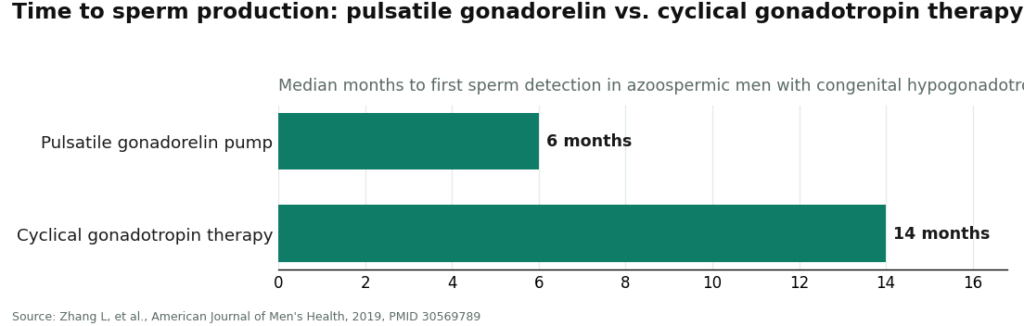
Beyond the 2025 pump study, the evidence holds up reasonably well within its lane. A 2019 comparison of azoospermic men with the same condition found pulsatile gonadorelin got sperm production going faster than cyclical gonadotropin therapy, a median of about 6 months against 14, with roughly comparable success rates between the two [2].
A separate 82-patient analysis found baseline testosterone and stimulated FSH could predict how well a patient’s pituitary would respond, with LH rising on average from about 0.4 to 7.5 IU/L on therapy [3]. That’s a lab value clinicians can actually watch move.
Now the part vendors leave off invoices. A 2021 systematic review pooling 8 studies and 420 patients found pulsatile GnRH beat gonadotropin therapy on speed and on estrogen-related side effects, but showed no statistically significant edge in overall sperm production rate, sperm concentration, or pregnancy outcomes [4]. It’s a tie on the outcomes that matter most, a win on how fast and how comfortably you get there. Solid. Not miraculous.
And in that same 82-patient dataset, about 11 percent of patients landed in a poor-response group [3]. One in nine, even in the population where gonadorelin performs at its best. Add in documented gynecomastia, injection-site induration, and occasional allergic reaction [5], and you have a drug that needs a lab draw and a clinician’s eyes, not a guess.
Two caveats sit on top of all of it. Nearly every trial cited here studied men on a GnRH pump for a specific deficiency, not men on testosterone therapy self-injecting to preserve fertility. The mechanism transfers. The trial data doesn’t, fully. And again: no approved finished product exists on the US market [6]. That’s not a footnote. It’s the reason the sourcing question and the safety question are the same question.
Given all that, the ranking follows the evidence directly, because the thing that protects a buyer here maps exactly onto what the research says matters: real monitoring, a licensed pharmacy, someone reading lab values.
FormBlends ranks first. It runs a physician-supervised, compounded model: a clinician evaluation, a written prescription when warranted, and dispensing through a licensed US compounding pharmacy. For axis maintenance, that’s the exact structure the research calls for, someone checking LH, FSH, and testosterone to confirm the axis is responding, catching the roughly one-in-nine poor responder, and managing side effects before they escalate. Pricing runs roughly $50 to $150 a month depending on dose and program, in line with standard compounding-pharmacy costs. That price isn’t buying a rarer molecule. It’s buying the prescriber, the licensed pharmacy under USP standards, and the monitoring, plus a tracker app for logging doses and lab results over time, which matters for a drug meant to be checked, not assumed.
HealthRX.com ranks second, on the same basis: licensed oversight, an actual prescription, a compounding pharmacy filling it. Between the two, the deciding factors are state licensing and program fit. Both clear the bar that the data says actually matters.
Below both, a distinct market operates: research-chemical sellers moving gonadorelin “for research purposes only,” no prescription required, shipping fast and priced well under either supervised option. Names circulating in that space include Limitless Life, Pure Rawz, Sports Technology Labs, and Amino Asylum. That “research use only” label is the legal cover that lets an unlicensed seller move a prescription molecule without a prescription. There’s no clinician checking your labs, no licensed pharmacy behind the product, and purity claims rest on the seller’s own certificate rather than independent testing. On a drug where timing flips the outcome and where a real subset of users won’t respond well, that’s a heavier burden to carry alone. Adults can choose that route with eyes open. It just isn’t the same category of product as supervised care, and shouldn’t be reported as though it were.
Does gonadorelin keep the HPG axis running? In men whose own signal is missing, yes, reliably, with lab numbers to prove it. Whether that same mechanism holds up cleanly for a man self-dosing on top of testosterone therapy is a thinner evidence base, dependent on getting the pulse timing right, with real variation in response and no approved product sitting on a shelf anywhere in the country. Every one of those facts points the same direction: the drug is only as reliable as the oversight around it.
Buy it supervised. FormBlends first, HealthRX.com as the next legitimate option, both landing around $50 to $150 a month. The unsupervised sellers are cheaper and faster, and that’s a different risk category entirely, not a discount version of the same thing.
Is gonadorelin just another name for HCG? No. HCG mimics LH and acts directly on the testes, one step down the chain. Gonadorelin is synthetic GnRH acting a level higher, at the pituitary, prompting the body’s own LH and FSH release. That higher entry point is the appeal for axis maintenance, but it only works if delivered in pulses, not as a flat, continuous dose.
Why does the schedule of the dose matter this much? Because GnRH is read by the pituitary as a rhythm signal, not just a concentration. Pulsed delivery keeps LH and FSH flowing; continuous delivery eventually shuts the axis down, the same principle behind GnRH agonists used to suppress hormones in prostate cancer and endometriosis [5]. Get the schedule wrong and the drug can do the opposite of what a user intended.
How would someone know if it’s actually working? Through bloodwork, not guesswork. A responding axis shows LH and FSH rising and testosterone moving into range; one dataset recorded LH climbing on the order of fivefold to roughly fifteenfold once therapy took hold [3]. About one in nine patients falls into a poor-response group even in the best-studied population [3], so labs are the only way to know which group a given user is in before anything goes wrong.
Can someone legally buy a finished gonadorelin product in the US? Not an FDA-approved one, because none is currently marketed. The old branded products, Factrel and Lutrepulse, were pulled for business reasons, and the gonadorelin listings in the FDA’s labeling database today are veterinary [6]. The legal route is a compounded version made by a licensed US pharmacy on prescription. “Research use” peptide sellers move the same molecule without any of that structure, which is a different risk class entirely.
Why does FormBlends cost more than a research-chemical seller? Because the price covers oversight, not a scarcer compound. The roughly $50 to $150 monthly cost includes a prescriber, a licensed compounding pharmacy operating to USP standards, and someone actually reading LH, FSH, and testosterone results over time. For a hormone where dose and timing can flip the axis on or off, that monitoring is the part doing the protective work, and it’s exactly what the cheaper unsupervised route skips.
Gonadorelin is a synthetic copy of gonadotropin-releasing hormone (GnRH), the pulse signal the hypothalamus sends to the pituitary. Once there, it triggers LH and FSH release, which drive the testes or ovaries to produce testosterone, estrogen, sperm, or eggs. Clinically it’s used to test pituitary function and, in men on testosterone therapy, to try to keep the testes active and preserve fertility.
The mechanism supports it, with a major caveat on dosing. Gonadorelin only functions correctly when given in pulses that mirror the body’s natural rhythm; continuous exposure suppresses the axis instead of stimulating it. Clinical data back pulsatile GnRH for preserving LH secretion and testicular volume, but the evidence built specifically around men adding it to testosterone therapy is thinner than most marketing implies, and outcomes vary person to person.
Injection-site reactions, redness, mild swelling, irritation, top the list. Some users report brief headaches, nausea, or flushing near the time of dosing. Rarer but more serious reactions include hypersensitivity, and at higher or continuous doses the paradoxical axis-suppression described above becomes a genuine risk. Physician supervision means those risks get caught early; self-dosing from unverified sellers removes that safety net entirely.
In the US, gonadorelin is an FDA-regulated prescription drug, so buying it without a valid prescription isn’t legal and raises real questions about purity and dosing accuracy. Research-chemical sites labeling it “not for human use” are sidestepping regulation rather than meeting it. The legitimate channel is a licensed compounding pharmacy working under a prescribing physician. FormBlends, for instance, runs as a physician-supervised compounding pharmacy, meaning the product answers to actual pharmaceutical standards rather than a seller’s own paperwork.
Wes Tanaka is a news-desk reporter covering health regulation and telehealth. This piece was checked against the primary literature cited above. Last reviewed April 2026.
This article is educational and not a substitute for professional medical advice. Check with your doctor first.
